Enabling Student Success
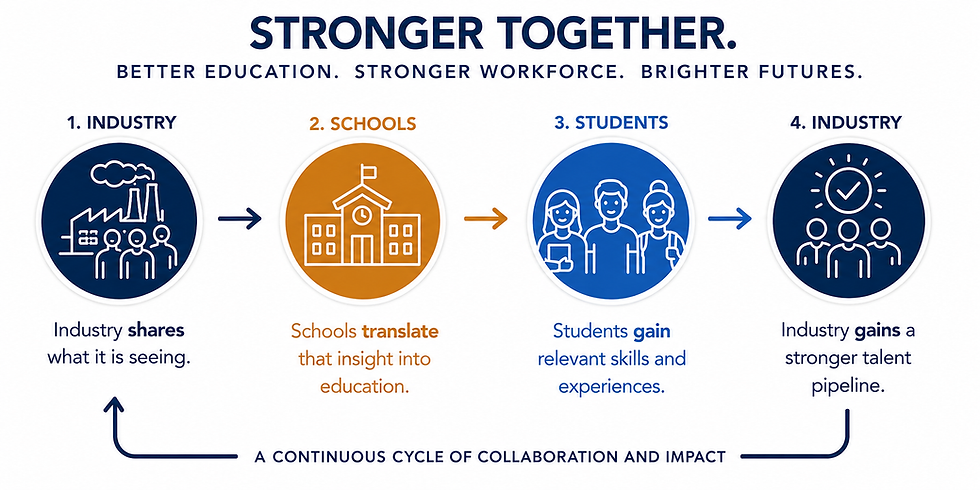
We talk a lot about connecting schools and industry, advisory boards, curriculum alignment, and building the talent pipeline.
But ultimately, there is one person who should be at the center of all of it: the student.
Because the goal of an education-industry partnership isn't simply to make a program more responsive to employers. It's to give students a better understanding of where their education can take them and the skills, experiences, and connections they need to get there.
Students need more than a classroom.

A student can learn about advanced manufacturing and robotics, they can learn cybersecurity, healthcare, engineering, construction, biotechnology, or environmental science. But there is a difference between learning about a career and experiencing one.
What does a manufacturing floor actually look like?
What does it feel like to work on a team solving a real problem?
What does an engineer actually do during a typical day?
What skills does an employer expect from someone walking through the door on their first day?
What does "being professional" really mean?
Don't you remember this when you first started? I remember going into engineering at WPI and truthfully having very little understanding of what an engineer did. I just knew I liked math and science.
Industry early on in someone's educational journey can make the connection real.
Don't worry, you don't have to bring in an intern right away (we'll work with you on that later)! Consider hosting workplace tours, a job shadow day, or developing a classroom project based on a real industry challenge. Think about future mentorships, internships, co-ops, or a teacher externship. Our teachers are so busy teaching that they have very little opportunity to pursue upskilling - an externship is a fantastic opportunity for both you and the teacher!
But let's acknowledge a challenge.
For employers, bringing high school students into the workplace isn't always simple.
Students may be under 18. There are questions about supervision, safety, child labor requirements, transportation, liability, workers' compensation, scheduling, and the additional administrative work that comes with hosting a young person.
And these concerns are legitimate. But don't let them stop you from participating.
Massachusetts has already built infrastructure to help create these connections. Programs such as School-to-Career Connecting Activities and STEM@Work are designed to connect high school students with employers and provide structured work-based learning opportunities. Massachusetts also has specific frameworks for cooperative education and work-based learning within career and technical education.
The answer isn't to ignore the risks.
It's to build the right structure and connections around the opportunity because we know schools and industry need each other. The connections are powerful and can make the difference our students need to be successful in whatever career they decide to pursue.
IndustryReady Partners helps make those connections happen.
We help schools move beyond simply asking, “Who will serve on our advisory board?” and instead ask "What experiences do our students need, and which industry partners can help us provide them?”
Whatever the task, let's remember to put the student at the center. Let's work together to give young people a firsthand understanding of the world they are preparing to enter.
And that's the real opportunity.
That's where partnership becomes possibility.
And that's where the future starts.

Comments